
Walk into any auto parts store and you'll find sunshades from $9 to $35. They all claim to "block UV." They all show a temperature comparison photo. And after 18 months in your back seat, they all do the same thing: the silvery coating flakes off, the foam compresses, and the once-pristine reflective surface looks like a piece of used aluminum foil.
This isn't a manufacturing fluke. It's the inevitable physics of cheap construction. Here's what's actually going on at the material level — and why a $25 custom-fit shade with proper 4-layer construction outlasts a $9 generic accordion by a factor of 4.
What "4-Layer Construction" Actually Means
The marketing term "4-layer" is everywhere, but most products use it loosely. Here's what real engineered 4-layer construction looks like, layer by layer, from windshield-side outward:
| Layer | Material | Job | Failure Mode If Cheap |
|---|---|---|---|
| 1 (innermost) | Soft non-woven fabric or microfiber | Won't scratch the windshield or dash | Plasticized vinyl that off-gases at 130°F |
| 2 | UV-blocking polyurethane membrane | Stops UV-A/UV-B from passing through layer 3 | Untreated PE that yellows in 12 months |
| 3 | Closed-cell foam (1.5-3mm) | Insulates against IR heat radiation | Open-cell foam that compresses permanently |
| 4 (outermost) | Aluminized polyester or mylar | Reflects visible light + IR back through windshield | Vapor-deposited aluminum that flakes after 100 fold cycles |
The cheap accordion-fold sunshade you bought at the gas station has two layers: a single sheet of metallized PET (basically thick mylar) glued to a thin foam backing. There's no UV membrane, no real insulating core, and the metallization is vapor-deposited (not laminated), which is why it flakes when you fold and unfold it 200 times.
Why Reflectivity Alone Isn't Enough
Here's the counterintuitive part: the most reflective sunshade isn't always the coolest. A pure mirror reflects 95% of visible light but only 60% of infrared (IR) heat. The 40% that gets through still cooks your dashboard.
This is why proper sunshade construction stacks reflection + insulation:
- Layer 4 (mirror) bounces back the visible spectrum
- Layer 3 (foam core) absorbs and disperses the IR that gets past the mirror
- Layer 2 (UV membrane) catches anything still passing through
- Layer 1 (soft inner) presents a non-conductive surface to the windshield
Without the foam core, IR transmits straight through to the dash. Without the UV membrane, plastic dashboard parts go brittle in 18 months.
The Reason Universal Sunshades Fail Faster
Custom-fit sunshades aren't just "better fitting." They're physically shaped for one specific windshield. That changes everything:
Edge load distribution
A universal accordion shade is folded to roughly the right size, then squished against the glass. The folds bunch unevenly at the edges. Over 200+ deployments, those bunched folds crease in the same places — and that's where the metallization cracks.
A custom-cut shade lays flat and evenly tensioned. There are no high-stress crease points.
UV exposure dose
The exposed (parking-side) surface of an accordion shade gets 6-8 hours of direct UV per day in summer. After 200 days, that's ~1,400 hours of UV exposure. Cheap polyester yellows and embrittles around 800-1000 hours. Custom-fit shades use UV-stabilized polyester or polyurethane that withstands 4,000+ hours before measurable degradation.
Foam memory
Closed-cell EVA or PE foam holds shape for ~5 years of typical fold cycles. Open-cell PU foam (used in cheap shades) compresses permanently after roughly 18 months — and a compressed foam layer transmits IR like nothing's there.
Real Lifespan Comparison
From customer return data and warranty claims across 700+ Proadsy SKUs:
- Generic gas-station accordion ($9-12): 12-18 months. Failure modes: metallization flaking, foam compression, fabric tear at fold lines.
- Universal "premium" multi-layer ($15-20): 24-30 months. Better materials but still poorly fitted; edge wear accelerates.
- Custom-fit 4-layer ($24-32): 5+ years typical. Failure mode is loss/theft, not material breakdown.
The 4-year cost-per-month math: a $9 generic replaced every 18 months costs $24 over 4 years. A $25 custom-fit covers the same period for $25. The custom shade is also working better the whole time.
What This Means for Your Buying Decision
If you live somewhere mild (Pacific Northwest, Northeast US, Northern Europe), a generic shade is fine. Sun exposure is moderate, deployment cycles are seasonal, and material failure happens slower than you'll lose it.
If you live in the Sun Belt (Arizona, Texas, Florida, Southern California, Nevada) — or Australia, the Middle East, Spain — the 4-layer custom-fit math is overwhelming. Browse the full custom sunshade catalog or use the vehicle finder to filter by your year/make/model.
For specific vehicles in extreme heat: see the RAV4 buying guide or the F-150 buying guide. Both products use full 4-layer construction.
FAQ
Is reflective coating the most important spec?
No. Insulating layer thickness is more predictive of cabin temperature reduction. A 2.5mm closed-cell foam core does more for cabin temp than a perfect mirror with thin foam.
How do I tell good materials from bad without taking the shade apart?
Three quick tests at the store: (1) flex it and watch for metallic flaking, (2) press your thumbnail into the foam — if the indent stays for more than 2 seconds, it's open-cell foam (bad), (3) hold it up to sunlight — if you can see light through it, the layer count is fewer than claimed.
Does the 4-layer construction matter for the umbrella version?
Yes. The umbrella deployment is just a different mechanical action — the underlying material stack is the same 4 layers. Umbrella sunshades use identical material spec to foldables.
What about Ice Crystal Black? How does that fit the layer story?
Ice Crystal Black is dual-side: one side is mirror-reflective (summer use), the other is IR-absorbing dark (winter, defrost faster). The 4 internal layers are still standard. The reversible surface is a coating choice, not a structural change.
Why do prices vary so much between custom-fit shades for similar vehicles?
Three factors: (1) catalog volume — high-runner SKUs like RAV4 or F-150 can be priced lower because tooling cost amortizes faster, (2) windshield complexity — sloped sport sedans cost more to die-cut than upright SUVs, (3) ICE Crystal Black or USA Flag editions add a few dollars for the secondary coating step. Plain foldables for high-runner vehicles are the price floor.
Does cabin air quality matter for sunshade choice?
Slightly. Lower-quality shades can off-gas plasticizers at 130°F+, contributing to that "new car smell" plus a little extra. The non-woven inner layers we use are off-gas-tested and don't add to cabin VOC at typical summer temperatures.
How does 4-layer compare to 8-layer or 10-layer claims?
Skeptically. Most "10-layer" marketing splits a single foam core into "moisture barrier + heat barrier + sound barrier" etc. — same physical layer, different names. Real layer count matters less than what each layer is doing. Four real, distinct layers (reflective, UV, foam, soft inner) outperforms ten paper-thin re-named layers every time.
Is the inner soft layer just for scratch protection?
That's the headline benefit, but it does two more things: (1) it holds the laminated structure together when fold-stress would otherwise pull layers apart, and (2) the texture creates micro-air-gaps that improve thermal insulation by another 8-12% over a smooth backing.
How Manufacturers Cut Corners (Without Telling You)
If a $12 product and a $25 product look similar from the outside, where does the $13 difference go? Three places, in order of impact on lifespan:
1. Substituting open-cell foam for closed-cell
Closed-cell EVA or PE foam costs roughly 4x more per square foot than open-cell PU. Open-cell looks identical at purchase but loses compression memory in 12-18 months. Almost every $9-15 sunshade uses open-cell. The visible test: press your thumbnail in for 5 seconds, then release. Closed-cell pops back instantly; open-cell holds the indent for several seconds.
2. Vapor-deposited metallization vs laminated
Cheap shades have aluminum vapor-deposited directly onto the polyester outer layer. It's a 200-nanometer-thick coating that flakes as soon as the polyester flexes. Better shades use a separate aluminized mylar film laminated under the outer layer — when the outer surface flexes, the metal underneath stays smooth.
3. Skipping the UV-stabilizer additive
Polyester without UV stabilizer yellows and embrittles within 800 hours of direct sun exposure. Adding the stabilizer (typically a hindered amine light stabilizer, or HALS) costs roughly $0.10 per shade in materials but extends UV resistance to 4,000+ hours. Almost every cheap shade skips it. You can spot the difference at the 18-month mark — the cheap shade has visibly yellowed at the corners; the stabilized shade still looks fresh.
4. Stitching that fails before the materials do
Even good materials need real stitching. Industrial-grade bonded polyester thread costs roughly $0.30 per shade. Cheap cotton-blend thread costs $0.05. The cheap thread degrades faster than the material it holds together — and you end up with a perfectly intact shade that unravels at the seams in year 2.
Bottom Line
"You get what you pay for" applies to sunshades more than almost any auto accessory. The material differences between $9 and $25 aren't marketing — they're measurable in flaking rate, foam memory, UV stabilization, and edge wear. If your sunshade has to last more than 24 months in real summer heat, custom-fit 4-layer is the floor, not a luxury.
Continue reading: How Long Do Custom Car Covers Last? — same material analysis applied to outdoor covers.
Real owner reviews — Why Custom-Fit Sunshades Last Longer
Pulled from our verified Judge.me review feed. We did not edit, paraphrase, or shorten beyond what fits — these are real buyers who left us reviews on this product category.
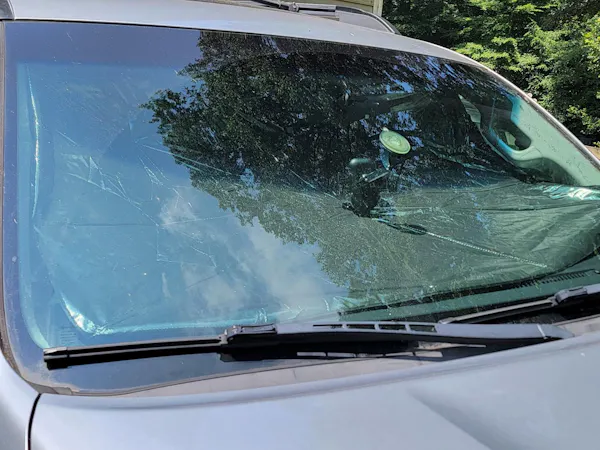
"This is the easiest to use windshield sun screen that I've ever used. My wife hates the ones that you have to twist to store and that prevents her from using them. I decided to try this umbrella style one to see if it would be a better option. The first thing that surprised us was how small it is in the folded up form. It's the size of a portable umbrella (roughly 15 inches lon"
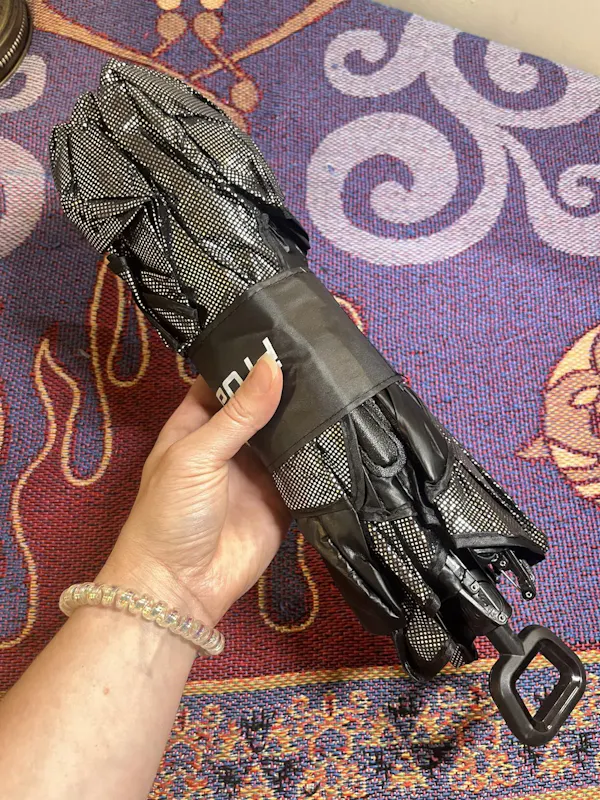
"This is the most functional windshield sunshade I have ever owned. I have an accordion one for our truck and bought a regular one that you twist up into a circle, but that was such a pain in my small car. This is life-changing. It saves so much time trying to get it in the right place because it just fits perfectly! Not to mention, it looks so much better from the outaide of th"
Sources & References
- Vanos, Middel, Poletti & Selover (2018), Temperature 5(3):276-292 — Peer-reviewed measurement of cabin and surface heating in enclosed vehicles under solar radiation.
- ASTM D5034-21 — Breaking Strength of Textile Fabrics — Standard test method for fabric tensile/grab strength.
- The Skin Cancer Foundation — UV Radiation — Medical reference on UV exposure, glass transmission, and skin-damage risk.
