
You bought a custom-fit dual-layer coated sunshade. It blocks 99.4% of UV and keeps the dashboard surface cooler. It's cut to your windshield. And then a few months later it has crumpled corners, the silver coating is flaking, and the fabric plies look creased and compressed. The shade still kind of works, but it's lost some of its performance.
Almost every premature sunshade failure traces back to one of five storage mistakes. None of them are obvious. All of them are easy to fix once you know.
Mistake 1: Folding It Hot
The single most common mistake. You're rushing into the car, you grab the deployed sunshade, and you fold it down while it's still scorching hot from sitting on the windshield.
Why this hurts: the fabric plies and reflective coating soften when hot. Folding it hot sets permanent creases at the fold lines. After repeated hot folds, the coating at the creases starts to thin and crack — and that's exactly where you need maximum reflectivity.
Fix
Let the shade sit on your back seat or floor for a few minutes after deployment. Touch the surface — if it's still painful to leave your hand on, wait a little longer. The fabric recovers its shape once it has cooled.
If you're in a real hurry, drive with the AC pointed at the dropped shade for a bit — that cools it to a safe folding temp fast.
Mistake 2: Storing Behind the Headrest or in the Door Pocket
Convenient, but those are the two worst places for a folded sunshade.
- Door pocket: tight, narrow, forces the shade to bend into a "C" shape it wasn't designed for. The reflective coating cracks at the bend point.
- Behind headrest: the seat back rocks forward and back during driving, slowly grinding the shade against the seat structure. The inner soft layer wears through over time.
Fix
Keep the shade flat. Three good options:
- Trunk floor or under-seat tray — flat, dark, climate-controlled (ish)
- The included storage pouch — most quality custom shades come with a flat zippered pouch that protects the surface
- Between the rear cargo cover and the cargo floor — a thin slot, perfectly sized
What matters: store it flat, store it out of direct UV, store it where it doesn't get pinched or scrubbed.
Mistake 3: Leaving It Damp
Less obvious than mistake 1 and 2. Happens after rain or carwash.
If you deploy a sunshade on a windshield that just got rinsed (carwash, sudden rain) and then fold it without drying, moisture trapped between the layers creates two problems:
- Mildew on the inner soft layer — small black spots can show up within weeks, hard to remove
- Adhesive separation — the laminated dual-layer construction relies on bonded seams between plies; trapped moisture can de-laminate at the edges, where the layers visibly puff apart
Fix
Wipe both sides with a microfiber towel before folding. Takes seconds. If the shade is fully wet, deploy it across your back seat to air-dry before folding.
Mistake 4: Rolling Instead of Folding (or Vice Versa)
This is a design-specific mistake. Custom-fit sunshades are engineered for one of two storage methods:
- Foldable shades are designed to fold in fixed creases (usually a Z-fold pattern). Forcing them into a roll stresses the fabric plies and bends the reflective surface in directions it wasn't designed for.
- Umbrella shades are designed to collapse via a central spring mechanism. Folding them like a foldable shade kinks the spring permanently.
The cheap accordion shade you get free with an oil change is the only kind that genuinely doesn't care which way you store it — because it has no engineered structure.
Fix
Match storage method to design. Most custom shades have a "Z" or "M" fold mark on the inner surface — follow it. Umbrella sunshades collapse with a single push at the center stem; don't try to fold them flat.
Mistake 5: Stacking Items on Top in the Trunk
You drop the folded shade in the trunk, then groceries on top, then the kid's bike. Over months of daily compression cycles, the shade's plies lose their spring. The reflective coating develops micro-fracture lines wherever a heavy point pressed.
You can see this happen if you look at an older shade against a new one — the old one has random "bruise" patterns where things pressed too hard.
Fix
Either store the shade in a dedicated location (trunk floor under the carpet, side wall pocket, between cargo cover and floor) or use the included storage pouch which adds compression protection.
Bonus: Cleaning Without Wrecking the Reflective Coating
Two things to know about cleaning:
- Microfiber + water only. Skip Windex, citrus cleaners, and any solvent. The reflective metallization is bonded with a polyurethane laminate that solvents weaken.
- Inside-out direction. Clean the inner soft layer with a dry microfiber. Clean the reflective outer layer with a damp (not wet) microfiber. Light circular motion. No scrubbing.
If you have a stuck-on bird dropping, let it dissolve for a few minutes with plain water before wiping. The acid in droppings is what damages reflective coatings, not the wiping force.
Why Storage Habits Matter
Storage habits compound over time. Each mistake above adds a little wear — creases, cracked coating, compressed plies — and the effects stack up. Simple storage discipline is the easiest way to keep a shade performing as designed, and the labor of using it well is essentially zero.
For New Sunshade Buyers
If you're shopping right now and want to set yourself up for a long-lasting shade from day one:
- Confirm the shade comes with a flat storage pouch — most Proadsy SKUs do
- Check that the inner backing is non-woven fabric, not vinyl (vinyl inners damage faster)
- Read the fold-pattern instructions before first use — it sets habit
- If you live in a humid climate (Florida, Gulf Coast), the dry-before-fold habit matters most
For a buying-side guide, see why dual-layer coated construction lasts longer. Browse the full sunshade catalog or use the vehicle finder to find your year/make/model.
FAQ
What if I already see flaking — is the shade ruined?
Depends on how much. Light flaking at fold creases is cosmetic; the underlying air-gap insulation still works. Widespread coating loss drops thermal performance enough that replacement is justified.
Can I patch a torn inner backing?
Small tears can be glued with a fabric repair patch. Larger tears expose the inner ply and accelerate degradation; replacement makes more sense.
How often should I clean the shade?
Quick microfiber wipe as needed during summer use, with a fuller clean once in a while. Don't over-clean — the more solvent contact, the more degradation.
Is it OK to leave the shade in a closed car overnight in summer?
Yes — the shade itself can handle it (it was designed for windshield-side parking). The mistake is folding it back hot in the morning. Pull it down, leave it on the back seat, fold later when cooler.
Does the warranty cover wear-out?
Proadsy's warranty covers manufacturing defects (delamination, stitching failure) for 2 years. Normal wear (fading, crease compression) isn't a warranty claim — but careful storage means you don't need one. See the fitment & warranty page for full terms.
Travel Storage: Long Trips, Garage Storage, Off-Season
Three storage scenarios that need different approaches:
Long road trip
You'll deploy and stow the shade multiple times daily, often in unfamiliar parking. The risk: rushing the fold during a quick stop, or storing on top of luggage. Best practice: keep the shade in its pouch on the back seat (not the trunk under bags) so you can stow it flat without disturbing other cargo.
Long-term garage storage (off-season)
If you live somewhere with real winter and don't use the sunshade for months at a time, store it flat in a cool dry place — not in the car trunk where it cycles between freezing and warming with the cabin. A flat shelf in the garage works; a hanging hook does not (the fabric creases where it touches the hook).
Two-car households with shared shade (don't do this)
You can't use one custom-fit shade across multiple cars unless they share an exact windshield. Even between two SUVs of similar size, the difference in fit is enough that one car gets a bad fit and the shade wears unevenly. Buy a shade per car.
Replacement timing
Replace when you see any two of these signs: visible coating loss, fabric visibly thinner at the creases, fabric tear at fold lines, or yellowing on the inner soft layer. Don't wait for catastrophic failure — performance has dropped well before that.
Bottom Line
Sunshades are mechanically simple but materially complex. The construction that makes them work — reflective coating, hollow air-gap, fabric plies — all degrade differently under stress. Storage discipline (cool before folding, flat-storage location, dry, match-the-design fold pattern, no compression) makes a real difference in how long the shade keeps performing.
Continue reading: Window Tint vs Sunshade — comparison of cost, performance, and legal limits.
Real owner reviews — Storing Your Sunshade
Pulled from our verified Judge.me review feed. We did not edit, paraphrase, or shorten beyond what fits — these are real buyers who left us reviews on this product category.
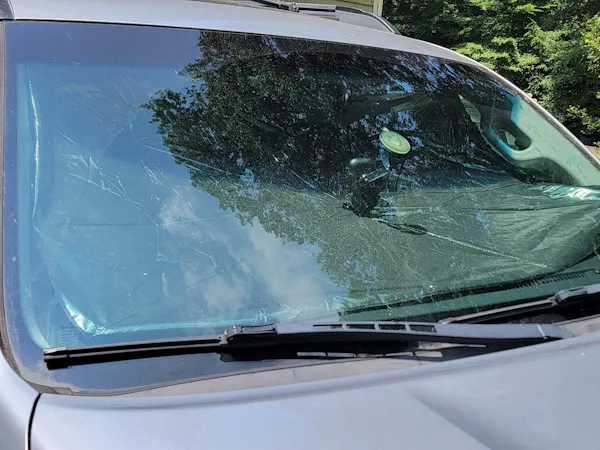
"This is the easiest to use windshield sun screen that I've ever used. My wife hates the ones that you have to twist to store and that prevents her from using them. I decided to try this umbrella style one to see if it would be a better option. The first thing that surprised us was how small it is in the folded up form. It's the size of a portable umbrella (roughly 15 inches lon"
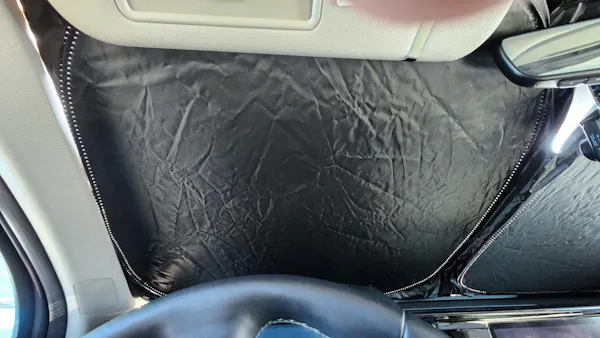
"Update: I added a photo from the inside of my car on how well it fits.This is, hands down, one of the best sun visors I have ever had. Fits my '23 Kia Sorento perfectly. It's easy to use and folds up nice for storage in it's little bag. It folds up easily and pretty flat; I can stuff it in the pocket behind my front seats! What makes this work so well, though, is that when it "
Sources & References
- Vanos, Middel, Poletti & Selover (2018), Temperature 5(3):276-292 — Peer-reviewed measurement of cabin and surface heating in enclosed vehicles under solar radiation.
