Tesla Sunshades and Custom-Fit Accessories — What Tesla Owners Should Know
Tesla owners ask us about custom-fit sunshades more often than owners of any other single brand. The honest answer up front: Proadsy does not currently offer Tesla-specific windshield sunshades or car covers. We're working on it. This page exists to give Tesla owners three things while we develop those fitments — practical knowledge about how Tesla's sensor systems and glass design affect sunshade choice, EV alternatives in our catalog that solve overlapping problems, and a way to be notified when Tesla fitments launch.
Why We're Taking the Time
Tesla's vehicle architecture is unusually integrated. The Model 3 and Model Y windshield connects directly to the panoramic glass roof on the same plane — a one-piece "greenhouse" design that means the windshield's upper edge has unusual sealing geometry. Designing a sunshade that fits flush at the top, accommodates Tesla's Autopilot camera array, and works with the rain/light sensor placement requires specific test fitments on multiple model years (Tesla refreshed the Model 3 in 2024 and the Model Y is undergoing a 2025 refresh as well). We don't want to ship a "close enough" universal sized for Tesla — that's the exact problem Proadsy was built to fix on every other brand.
If you'd like to be notified the moment Tesla fitments launch, sign up to the newsletter at the bottom of any Proadsy page footer. We send one email per launch — no spam.
Tesla Lineup Overview
| Model | Years | Windshield Profile | Notable Features |
|---|---|---|---|
| Model 3 | 2017-2026 (refresh 2024+) | Steeply raked, narrow top | Glass roof; AP cam cluster |
| Model Y | 2020-2026 (refresh 2025+) | SUV-coupe; wider than Model 3 | Glass roof; AP cam; rear hatch glass |
| Model S | 2012-2026 (Plaid 2021+) | Sedan; long, raked | Yoke option; HUD; full glass roof |
| Model X | 2015-2026 | SUV; falcon doors | Largest single-piece windshield in production |
| Cybertruck | 2024-2026 | Single-piece, low-rake; trapezoidal | Stainless body; integrated wiper |
Each of these has unique sunshade requirements. The Model 3 and Y can in theory share a shade design with significant adjustment, but the Y's slightly wider top and SUV-coupe rear visibility make a single shade design awkward. The Model X's panoramic windshield (it extends partway over the front-seat passengers' heads) is essentially a different category of glass — you cannot put a foldable shade against it the way you can on every other car.
What Tesla Owners Need to Know About Sunshade Choice
1. Autopilot Camera Cluster
All Tesla vehicles since 2017 have the Autopilot/Full Self Driving camera array mounted in two places: a forward-facing trio of cameras at the top center of the windshield (behind the rearview mirror), and side-facing cameras in the B-pillars (not relevant to windshield shades). The forward cluster occupies roughly a 5-inch wide by 4-inch tall area.
Generic sunshades that don't have a notch for this housing will press against the camera lenses. Tesla doesn't display an obstruction warning at startup like Toyota TSS does — instead, Autopilot simply silently refuses to engage when you try to activate it on the highway. Owners often don't realize the sunshade is the cause.
The takeaway: any Tesla sunshade — including any future Proadsy fitment — needs an explicit cutout for the AP camera cluster. The cluster is wider than on most other vehicles.
2. Glass Roof Greenhouse Effect
Tesla's panoramic glass roof (standard on Model 3, Y, S, and the rear half of the X) covers roughly 30 square feet of glass. The glass has IR-blocking coating that reduces infrared by about 80%, but the remaining 20% is enough to drive cabin temperatures to 130°F+ on a 100°F day. A windshield sunshade addresses only the windshield — the roof remains uncovered.
This means the windshield sunshade's job on a Tesla is more important than on a typical sedan. The roof is doing a portion of the heat-blocking work, but everything that gets past the windshield arrives at a dashboard that already has heated air pooling above it from the roof. Sunshade quality matters proportionally more.
3. Touchscreen Sensitivity
Tesla cars have no traditional gauge cluster — every piece of vehicle information is on the central touchscreen (15-inch on Model 3/Y, 17-inch on Model S/X). Tesla touchscreens have shown long-term degradation under sustained UV and heat exposure, with some early-vintage Model S and X cars (2012-2018) experiencing screen yellowing or "MCU" (media control unit) failures attributed in part to thermal stress.
Tesla extended warranty on certain MCU components after this became widely reported, but out-of-warranty replacements run $1,500-$2,500. A sunshade that keeps the dashboard 30-40°F cooler is the cheapest preventive measure available.
4. Range Impact
The most concrete reason to use a sunshade on a Tesla is range. EV efficiency drops sharply when starting a drive in a hot cabin because the AC has to work much harder, and battery thermal management runs harder during the trip. Studies of real-world Model 3 efficiency in summer conditions show 15-20% range loss when ambient is 95°F and the cabin starts at 130°F. A sunshade reduces the cabin starting temperature by 30+ degrees, which roughly halves the AC's initial load.
Over a year of summer driving, that's hundreds of miles of recovered range — not insignificant for daily commuters or long-distance road trippers.
EV Alternatives in the Proadsy Catalog
While we don't have Tesla fitments, we do have custom-fit sunshades for five other premium EVs that share most of the same design considerations as Tesla — large central displays, glass roofs, IR-blocking glass that's not enough on its own, and similar AP-style sensor clusters that need contoured cutouts. If you're shopping comparison EVs or looking at non-Tesla options, these are the closest matches in the lineup:
- Hyundai Ioniq 5 — Tesla Model 3/Y alternative. Similar charging speed, comparable range, more interior space. Vertical windshield is the most squared-off of any EV in the lineup.
- Ford Mustang Mach-E — direct Model Y competitor. Coupe-rooflined SUV with a 15.5-inch portrait display similar to Tesla's. Mach-E sunshade fitment is dialed in for the steep windshield rake.
- Kia EV9 — three-row family EV. No direct Tesla equivalent (Model X is the closest but more expensive). Sunshade designed for the EV9's particularly wide windshield.
- Rivian R1T — Tesla Cybertruck alternative if you want an electric pickup that's available now and looks more conventional. R1T sunshade is the largest in the lineup due to the truck's expansive windshield surface.
- Lucid Air — Tesla Model S Plaid competitor. Best-in-class range. Steeply raked windshield with the most demanding sunshade geometry of any EV we make.
For broader EV context, the EV editions overview page covers all five.
Universal Sunshade Recommendations for Tesla Owners (Until We Have Fitments)
If you absolutely need a sunshade for your Tesla today, two interim recommendations:
- Skip the cheap "fits all Teslas" Amazon shades. They don't fit any of them well. A Model 3 shade sized for the AP camera will leave 2-3 inches of glass exposed on a Model Y. Same shade on a Model S will leave the top 4 inches uncovered. The "universal Tesla" listings are usually a Model 3 size with no AP notch.
- Look for Model-specific aftermarket shades from established brands. Several specialty retailers focus exclusively on Tesla accessories. Match the model and year carefully — the 2024 refresh Model 3 and the 2025 refresh Model Y have slightly different glass than earlier production years.
We'll update this section when Proadsy Tesla fitments launch.
Install Steps That Apply to Any Tesla
Generic install knowledge that's true regardless of which sunshade you end up using:
1. Position the Notch Around the AP Cluster First
Before sliding the shade's top edge behind the visors, line up the sensor cutout with the camera housing. If your shade has no notch, it will not work — the shade will press the cameras and Autopilot will refuse to engage on your next highway drive.
2. Tesla Visors Are Lower Than Most Cars
Tesla designed the visor to sit below the camera housing. The gap between the visor and the headliner is unusually small. You may need to extend the visor fully forward (toward the windshield) before sliding the shade's top edge through. Don't force it — if the shade catches, slide the visor forward another half inch.
3. Mind the One-Piece Glass Seal at the Top
On Model 3 / Y / S, the windshield meets the glass roof at a thin metal seal. The shade's top edge should sit just below this seal, not pressed against it. Pressure on the seal long-term can compromise weather sealing.
4. Bottom Edge Tuck Is Trickier on Tesla Dashboards
Tesla dashboards are unusually low and minimalist. The gap between the dashboard top and the windshield base is shallower than on most cars — about 1/4 inch on Model 3/Y. Folding the shade's bottom edge before tucking helps it grip without flexing the dashboard.
Frequently Asked Questions
When will Proadsy launch Tesla fitments?
We don't have a specific date. Sign up for the newsletter (footer of any page) to be notified at launch.
Will a Mach-E sunshade fit my Model Y?
No. Despite both being SUV-coupes with similar overall size, the windshield curvature and width differ by 2-3 inches. The AP camera cluster on the Model Y is also positioned differently from the Mach-E's Co-Pilot 360 housing.
What about the Cybertruck?
The Cybertruck windshield is single-piece, trapezoidal, and unlike anything else on the road. The integrated wiper geometry alone makes a sunshade design more complex. Cybertruck-specific shades, when they launch, will be a separate product from Model 3/Y/S/X.
Do Tesla car covers have the same problems?
Different problem. Car covers don't have to clear sensors like sunshades do, but they do need to accommodate Tesla's flush door handles (which extend automatically when the car detects the key fob). A loose or wrong-fit cover can interfere with door handle operation. As with sunshades, generic "fits Tesla" car covers tend to be wrong-sized.
What about side window shades?
Tesla side windows have unusual proportions — the rear quarter window on the Model Y is particularly large compared to most SUVs. Side window shades benefit from custom fit even more than windshields because they're held in place by suction or static cling, and a wrong size won't stay up.
What Sets Tesla Apart from Other EVs (And Why That Affects Sunshade Design)
Tesla's vehicle architecture is unusual in three ways that compound the sunshade-design challenge:
1. Single-Piece Glass Roof and Windshield
Most automakers join the windshield to the roof at a metal seam. Tesla uses a thin metal strip plus glass-on-glass continuity — the roof glass starts where the windshield glass ends, with minimal visible separation. This visual minimalism is part of the brand identity, but it means the sunshade has nowhere conventional to grip at the top edge. On a Toyota or Ford, the headliner overlaps the windshield by a half inch and the sunshade's top edge tucks under that overlap. On a Tesla, the headliner ends earlier and the visor mount becomes the only practical anchor.
2. Camera-Centric Sensor Architecture
Tesla famously eliminated radar and ultrasonic sensors in favor of cameras only. The forward-facing array consists of three cameras — wide, narrow, and main — clustered in a single housing. Compared to most other vehicles' single-camera plus radar setup, Tesla's housing is wider and has more critical lens area that absolutely cannot be obstructed. A sunshade design that works for a Toyota TSS 2.0 cluster may still leave a sliver of camera lens covered on a Tesla.
3. Vehicle-Wide OTA Updates
Tesla pushes software updates that occasionally change camera calibration sensitivity. A sunshade that was tested compatible in 2023 may behave differently after a 2025 firmware update if Tesla tightens the obstruction-detection threshold. This makes Tesla fitment design a moving target — we want to test against the current firmware behavior, not just the geometry.
Maintenance During Charging
One operational note specific to Tesla: many owners leave their cars at Superchargers for 20-45 minutes while running errands. Without a sunshade, the cabin can climb 30-40°F during a sunny Supercharger session. The car itself manages battery temperature with active cooling, but the cabin returns to driving condition baking hot.
Once Tesla fitments are available, the high-value scenarios are clear:
- Workplace destination charging: 8-hour parking under direct sun. Sunshade benefit is largest here.
- Supercharger road trip stops: 30-45 minute parking. Smaller absolute benefit but matters for the next leg of the drive.
- Overnight street parking in summer: 12-hour exposure. The morning starting cabin temp determines how hard the car has to precondition.
What's Next
If you're a Tesla owner who's read this far, three things you can do now:
- Sign up for the newsletter to be notified when Tesla fitments launch.
- If you're cross-shopping EVs or own a household with multiple EVs, the EV editions overview covers our existing five EV fitments.
- If you have specific feedback about what would make a great Tesla sunshade — Autopilot camera notch shape preferences, ice crystal vs reflective, fold pattern — message us via the contact page. We use customer input to prioritize fitment design.
Thanks for the patience. Tesla fitments are on the roadmap, and we want to do them right when they launch.
Real Tesla owner stories
From our verified Judge.me feed (6,000+ reviews across the Proadsy catalog). These are real Tesla owners who left us reviews — not paid testimonials, not edited.
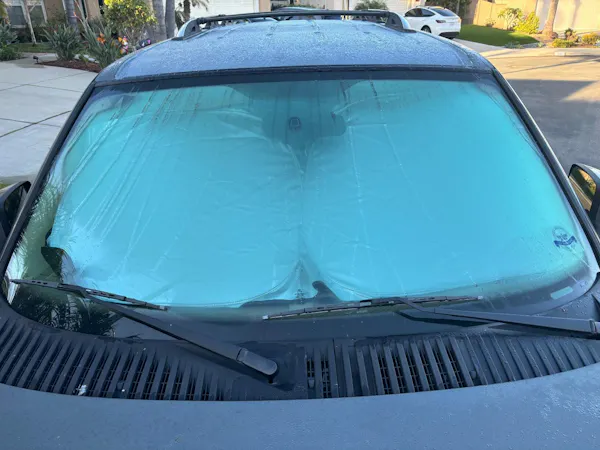
"To be clear, I got this knowing it may not fit my specific Expedition (Model Year 2004-2015). However, as you can see in the pictures, it fits great.I also really like that you can un velcro the material towards the top of the shade and re velcro it around the rear view mirror. Without this feature, there would be this bowing effect of the shade since it would have to go in front of the rear view mirror. With the fea"
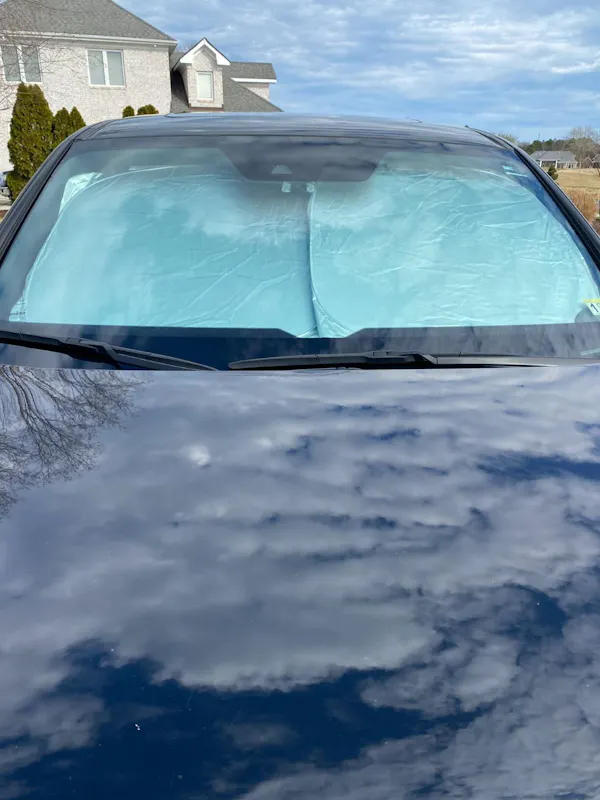
"Because it is model specific, it fits like a glove. Outside is reflective, inside is black. It completely covers the windshield and has a small velcro strap that secures it around the rear view mirror mount. Sun visors hold it firmly against the windshield. It easily folds up and fits into an included small bag that can be stowed under your seat. In my vehicle (Honda Ridgeline) it would not fit in the door stora"
"I wasn't sures this would fit since it's made for my other car but it did fit.. Just a tad wider than the windshield however it works fine.. So now I can use it in both cars.The quality is much better than the previous one I had replaced, where the material came away from the spines of the umbrella due to the holes punched with the plastic fabric fastener getting larger and larger due to daily tugging from regular us"
Fitment notes — what makes Tesla different
Tesla mounts a tri-camera Autopilot cluster against the top-center of every Model 3, Model Y, Model S, and Model X windshield — the housing is wider than most ICE-vehicle camera assemblies, which is why generic universal-fit shades bunch noticeably above the cameras on Tesla glass. Our Tesla patterns dip around the entire Autopilot housing including the side cameras. Catalog status: currently 0 Tesla SKUs are in active production — we are scanning Model Y (2020-2026) and Model 3 (2017-2026) and expect to ship in Q3-2026. Drop your email below to be notified when Tesla SKUs go live; meanwhile, we have full coverage for Hyundai Ioniq 5, Rivian R1T, Ford Mustang Mach-E, Kia EV9, and Lucid Air on the EV editions page.
